

Almost every week someone sends us a photo of a glass shower enclosure and asks the same question: “Can this be cleaned, or is it ruined?” The honest answer is that cloudy shower doors come from three very different problems — soap scum, mineral buildup, and etching — and they look almost identical in a photo. One wipes off with the right cleaner, one needs patience and an acid, and one is damage in the glass itself. Here is how to tell them apart at home before you spend money on the wrong fix.

Three causes of cloudy shower doors
1. Soap scum. Bar soap and some body washes react with the minerals in tap water and leave a waxy, greasy film. It is heaviest where you lather, smears under a dry finger and often looks slightly yellow or grey. Soap scum sits on top of the glass.
2. Mineral buildup (hard water deposits). Los Angeles water carries a lot of calcium and magnesium. Every droplet that dries leaves a tiny mineral ring, and over months those rings merge into a white, chalky haze, thickest low on the door and in the spray path. It feels gritty or sandpapery. It also sits on top of the glass — at first.
3. Etching. When mineral deposits are left for a long time, especially on glass that is wet and warm every day, the minerals and the alkaline residue slowly attack the surface of the glass. The glass itself becomes microscopically pitted. At that point there is nothing left to clean off, because the haze is the glass. Etched glass feels smooth but it stays dull no matter what you spray on it.
In real bathrooms the three often layer on top of each other, which is why a cleaner that “worked a little” can mislead you.
The water-drop test
- Dry a cloudy area of the door completely with a clean towel.
- Put a few drops of plain water on it, or wipe a small patch with a wet cloth.
- Look at that patch from an angle, against the light.
If the haze disappears while the glass is wet and comes back as soon as it dries, you are most likely looking at etching. Water fills the tiny pits in the surface and light passes through as if the glass were smooth. When the water evaporates, the pits scatter light again.
If the haze stays visible while wet, something is still sitting on the surface — soap scum, minerals, or both. That is good news: surface deposits can usually be removed.
Two follow-up checks narrow it down:
- The fingertip test. Slip your hand into a thin plastic sandwich bag and run your fingertips over the dry glass. Waxy drag means soap scum, gritty bumps mean mineral scale, and a smooth but dull surface points to etching.
- The vinegar test. Soak a paper towel in white vinegar, press it onto the haze for fifteen minutes, then wipe. If the spot clears or softens, it was mineral deposits. If a dish-soap-and-warm-water scrub clears it instead, it was soap scum. If neither changes anything, the water-drop result is confirmed.
Which of the three can be cleaned and which need restoration?
Soap scum is a cleaning job. A degreasing cleaner or dish soap, warm water and a non-scratch pad will take it off. Switching from bar soap to liquid body wash and squeegeeing after each shower keeps it from coming back.
Mineral buildup is also a cleaning job, but a harder one. Mild acids — vinegar, or a cleaner made for hard water — dissolve the scale. Never use steel wool, scouring powder or a razor blade on a shower door; those scratch the glass, and some shower glass carries a factory protective coating that abrasives can strip. If deposits keep returning within days, our article on why hard water stains keep coming back on shower glass explains how to break the cycle.
Etching cannot be cleaned, because nothing is on the glass. The only way to bring back clarity is to remove a very thin layer of the damaged surface with a proper glass polishing process, working evenly across the whole panel so there is no visible wavy spot. It is also exactly what our shower door glass restoration service does in homes across Los Angeles.
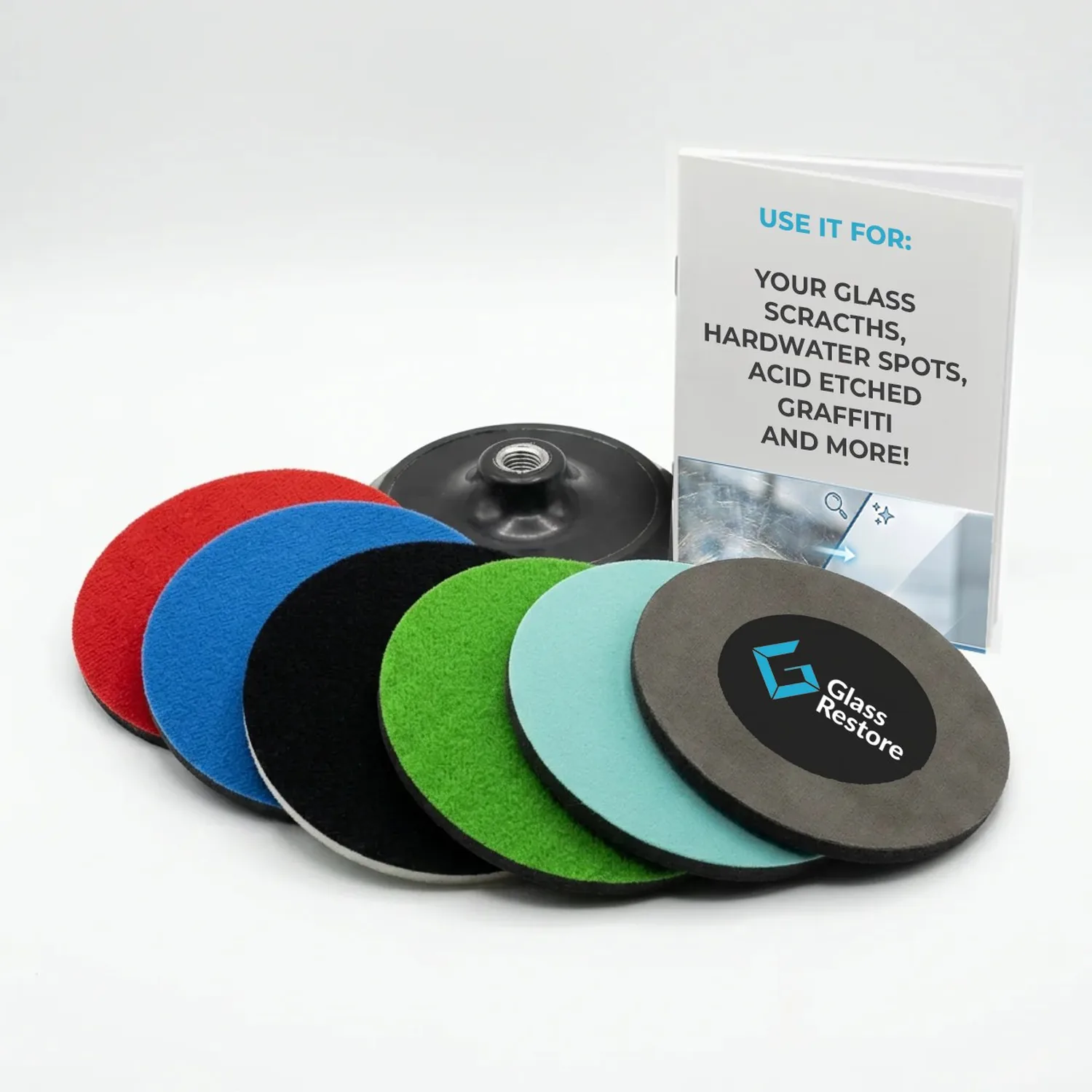
If you are comfortable doing careful work yourself, light etching and stubborn scale can be handled with our DIY glass restoration kit ($279). Property managers and cleaning crews with many enclosures to maintain usually choose the commercial scratch, acid graffiti and hard water kit ($499).
Why some doors are past saving
A few situations are outside what restoration can fix:
- Coated glass with a failed coating. Many newer doors ship with an easy-clean coating. Once that coating is etched and patchy, polishing removes it unevenly, and it cannot be put back by hand.
- Decorative or textured glass. Frosted, sandblasted, rain-pattern and acid-etched designer glass cannot be polished without destroying the pattern.
- Damage inside a laminated or double panel. Haze between layers is not reachable from the surface.
- Chips, cracks or deep scratches near the edges of tempered glass. Tempered glass carries stress at its edges; we will not work over damage that affects its safety.
- Extremely deep etching. Removing very heavy pitting would take off more glass than is sensible. We assess this before anything else.
In those cases the right call is a new panel, and we will say so plainly.
Not sure what is clouding your shower door?
Run the water-drop test, take a photo of the door wet and another one dry, and text them to us. We will tell you whether you are looking at soap scum, minerals or etching, and what it would take to fix it. Learn more about our shower door glass restoration and hard water spot removal services, or call or text 818-356-1345.