

Walk around almost any house in Los Angeles and look at the lower half of the windows facing the lawn. You will often see a white, speckled band that stops at exactly the height a sprinkler head can reach. Those are sprinkler overspray window stains, and they are the hard water problem that owners almost never catch in time. Shower glass gets looked at every morning. A window behind a hedge gets looked at when the house goes up for sale — and by then the minerals have often moved from sitting on the glass to living in it.
Why irrigation water is harsher than shower water
People assume water is water. On glass it is not. Three things make sprinkler water worse than the water that hits your shower door:
- It is cold and untreated. Many homes have a softener or filter on the indoor plumbing, but irrigation lines are usually plumbed before it. The sprinklers spray the full mineral load of the city supply — calcium, magnesium and silica — straight onto the glass.
- It never gets rinsed or wiped. A shower door gets a squeegee or at least a rinse now and then. A window gets sprayed, dries, and gets sprayed again tomorrow. Every cycle leaves a fresh layer of mineral on top of the last one.
- It carries more than minerals. Overspray picks up fertilizer residue, soil and whatever is on the leaves it passes through. Some of that is alkaline, and alkaline residue is exactly what attacks glass over time.
The result is a stain that builds in layers, like rings in a tree, on a surface nobody is watching.
How sun baking accelerates etching
In a shower, water dries slowly in a shaded room. On a south- or west-facing window in Southern California, a droplet can dry in minutes under direct sun. That fast evaporation concentrates the minerals in a tight ring, and the heat of the glass bonds them to the surface far harder than a slow dry does.
Then comes the part that turns a stain into damage. Glass is very durable, but it is not inert. When a mineral deposit is wet again every morning and hot every afternoon, the alkaline film under it slowly dissolves the top of the glass itself. The surface becomes microscopically pitted. This is etching, and at that point there is nothing left to clean off, because the haze is now the texture of the glass.
The warning sign is simple: the spots stop looking like spots. They look like a frosted patch, a dull fog in the shape of the spray pattern that you can see even when the window is freshly washed.
Adjusting sprinklers: the free fix most owners skip
Before any cleaning or restoration, stop the source. Otherwise you are polishing a window that will be re-stained next week. Walk the yard while the system runs and look for these:
- Heads aimed at the house. Most spray and rotor heads have an adjustable arc. Turn them so the pattern ends at the planting bed, not the wall.
- Pressure that is too high. High pressure turns water into mist, and mist drifts. If you see a fog around the head, reduce pressure or change the nozzle.
- Tilted or sunken heads. A head knocked sideways by a mower can send a stream straight at the glass. Straighten it.
- Timing. Watering in the early morning, before the sun hits that side of the house, lets droplets dry more slowly and gives you a chance to rinse.
- Drip where you can. Beds right against the house are often better served by drip irrigation, which does not spray at all.
When sprinkler overspray window stains cross from cleanable to etched
Here is how to tell which side of the line your glass is on:
- Still a deposit: the spots feel gritty or raised under a fingernail, and a mild acidic cleaner (white vinegar or a dedicated mineral remover left on for a few minutes) softens or removes them. If they disappear when the glass is wet and come back when it dries, they are still mostly on top.
- Already etched: the glass feels smooth but looks dull, the pattern stays visible when wet, and acid cleaners do nothing. Scrubbing harder will not help — and razor blades or abrasive pads on a stained window can add scratches to the problem.
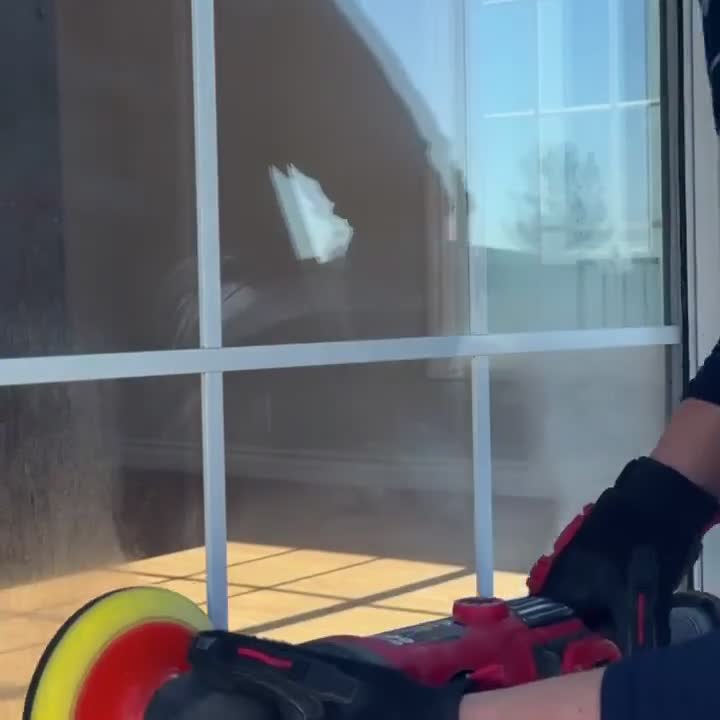
Mild etching can be polished out with the right compound and pads, because the goal is to take the surface down evenly until it is flat and clear again. That is what our DIY glass restoration kit ($279) is built for on a few home windows. For property managers and larger jobs, the Commercial kit ($499) covers scratches, acid graffiti and hard water spots on more glass.

What a professional looks at first
When we assess overspray damage, we check a few things before recommending anything: how deep the etching reaches, whether the glass is tempered or coated (Low-E and reflective coatings are often on the inside surface, but some are not, and they cannot be polished), and whether the source has been fixed. Heavy, deep etching over large areas is a judgment call, and we will tell you honestly what polishing can and cannot do on your specific glass.
After restoration, a protective coating makes future overspray bead up and roll off instead of drying in place. It does not replace fixing the sprinklers, but it buys you time.
Seeing white spots on the lower half of your windows?
Adjust the sprinklers first, then try the vinegar test on one spot. If the stain does not budge, take a photo of the window wet and another one dry, and text them to us. We will tell you whether it is a deposit, light etching or something deeper. Learn more about our hard water spot removal and glass scratch removal in Los Angeles, or call or text 818-356-1345.