

A tag lands on your window overnight, and by the time you unlock the door it is the first thing every customer sees. Storefront glass graffiti is one of the few kinds of damage where what you do in the first day decides whether the glass comes back clean or stays marked for good. Most of the permanent damage I get called out to look at was not done by the vandal at 2 a.m., but by whoever grabbed a razor blade and a bottle of solvent at 7 a.m.

Paint, scratch, or acid: reading storefront glass graffiti in two minutes
Three completely different things get called “graffiti” on glass, and they need three different answers. Sorting them out costs two minutes and changes everything that follows.
Paint and ink sit on top of the glass. Run a fingernail across the edge of a letter: the mark stands up off the surface and the glass underneath is still smooth. Under a flashlight held at a low angle the film has visible thickness and a hard edge. This is the friendly version.
A scratch is cut into the glass. A key, a screwdriver, a rock, a carbide scribe. The nail does not glide over it — it drops into a groove and catches. Scratched letters are thin and sharp, and they throw a fine bright line when light rakes across them.
Acid etch has no edge at all. Etching cream leaves a milky, frosted patch. It feels faintly rough but there is no groove to catch a nail, the outlines are soft and feathered, and there are usually drip runs trailing below the tag. The field test that settles it: wet the area with clean water. Paint and scratches look the same wet; an etch mostly vanishes while wet and reappears as it dries.
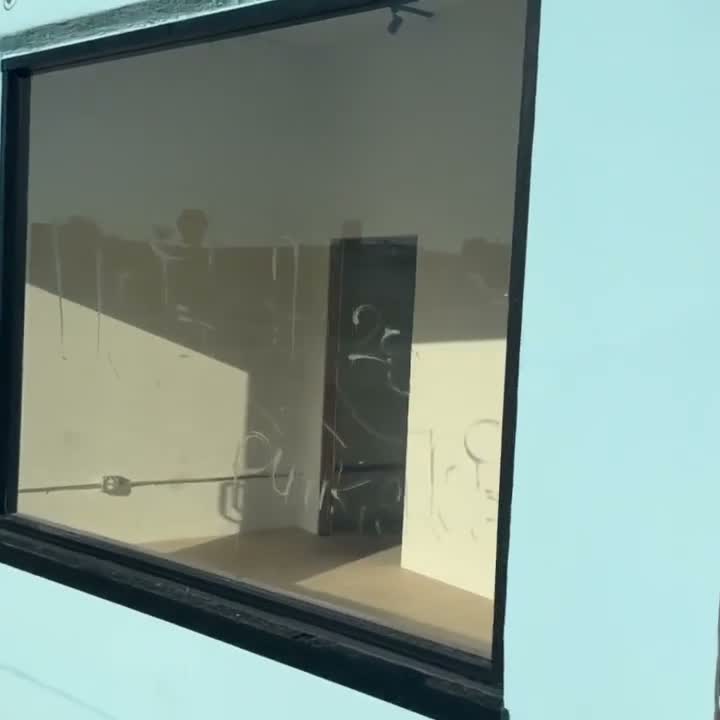
What not to do before help arrives
Every item here is something I have watched turn a one-surface job into a much bigger one.
- No razor blades. A dry blade drags street grit across the pane and lays down its own field of fine scratches. On tempered and coated glass a blade can leave permanent haze that no amount of cleaning touches.
- No masonry graffiti removers. Solvents made for brick and stucco do little to paint bonded on glass, and they happily attack anodized frame finish, gaskets, window film and low-E coatings.
- No scouring pads or abrasive powders. Scrubbing an etch with an abrasive adds a scratch field on top of it — now there are two problems on one panel.
- No pressure washing. It drives residue into the frame joints and does nothing about damage that is in the glass rather than on it.
- Do not tape paper or plastic over an etched area. That traps moisture against live residue — see the next section.
What you can safely do: gloves and eye protection on, bare skin out of it, and flood the area with plenty of clean water, running the runoff down and away from you, from planters and from pets. Dilution is the whole point. Then leave it alone.
Why acid etch keeps working after it looks dry
This is the part that surprises store owners. Etching cream is not a coating that dries and stops. It dissolves the surface of the glass, and when the paste dries into a crust it can still hold acid that never finished reacting. Every time that spot gets damp again — the marine layer overnight, a hose, a window cleaner’s wet rag — the residue goes back to work in place. The drips do the same, etching the glass they ran over. That is why one word on Monday becomes a word plus a curtain of haze by Friday.
The other thing to understand: an etch is missing glass. There is nothing to wash off, and no cleaner brings it back. Restoring it means bringing the whole surface back down flat and clear in a controlled way — that is what acid etched graffiti removal actually is, and why it is a different job from wiping off spray paint.
The photos that get you a real assessment
Nine out of ten photo sets I receive are one blurry close-up. Six quick phone shots, taken before anything is cleaned, tell us everything:
- The whole panel, straight on, far enough back that the frame edges are in the picture. That gives us the panel size.
- Something for scale taped beside the damage — a business card, a tape measure, your hand.
- A close-up from about a foot and a half away, focused on the marks themselves.
- A raking-light shot: stand off to the side so a reflection of the sky runs across the damage. This frame shows whether the marks are sharp lines or a soft field, and how much of the surface is involved.
- One shot from inside looking out. Which side the damage is on is the most common thing missing from the photos we get.
- Every affected panel, not just the worst one. Counting panels is half the assessment.
Keep the originals with their timestamps. If you file a police report or a claim, dated photos taken before any cleanup beat anything reconstructed later.
Handling small tags in-house
If you run a property with recurring hits and the marks are small and isolated, a first pass in-house is reasonable. The DIY glass restoration kit ($279) covers a panel-at-a-time situation; the commercial kit ($499) is the version maintenance crews ask for. Widespread acid damage across a full elevation is a different animal, and so are deep scratches — worth a look from someone who does it daily before you start.
Call before you scrub
If your glass got hit last night, the cheapest call you make today is the one before anyone touches it. Send the six photos and the panel count, and we will tell you straight what is on the glass and what is in it.
Glass Restore — call or text 818-356-1345. More on what we do for retail and commercial frontage: storefront glass restoration and glass scratch removal in Los Angeles.