

Film gets sold as one product and it is really three, doing three unrelated jobs. Getting privacy film installation right starts with deciding which problem you are actually solving — the office that needs a wall it can see through, the storefront that keeps getting tagged, or the glass that is already damaged and needs restoring before anything goes on it.
Privacy film
This is the one people picture: frosted, tinted or patterned film that blocks the view through a pane while keeping the light. Conference rooms, clinic partitions, street-facing offices, bathroom windows and the glass beside a front door.
Two practical notes before choosing a finish. Frosted film diffuses — nobody sees shapes through it, in either direction, all the time. Reflective film works by contrast, so it only screens the side that is brighter: a mirrored storefront that hides the interior by day becomes a window at night when the lights are on inside. If the point is privacy after dark, reflective film alone is the wrong pick.
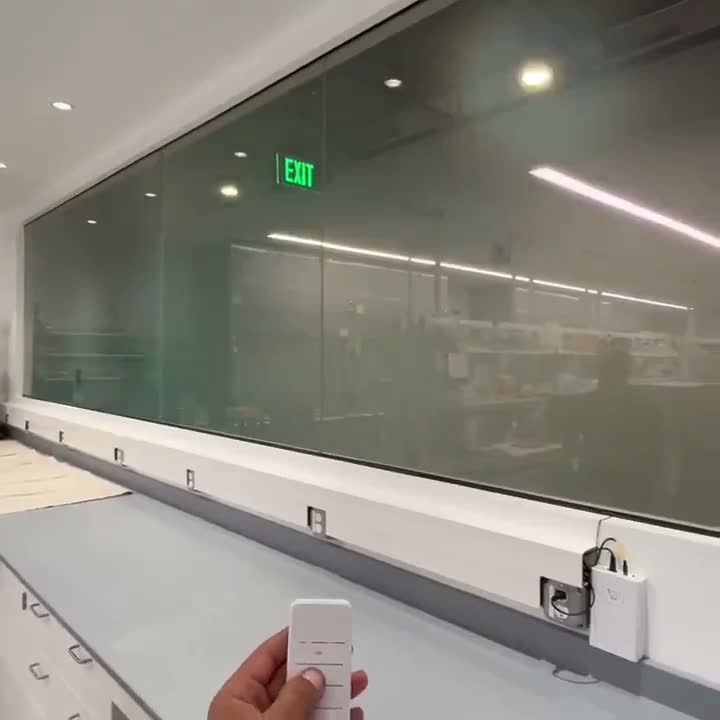
Switchable panels are the third option — clear on demand, opaque at the flick of a controller, which is what the photo above shows. They cost more and they need power at the glass, so they suit a partition designed for them rather than a retrofit on an existing pane.
Protective and anti-graffiti film
This film is not decorative. It is a clear sacrificial layer applied over the outside face so the next scratch tag, etched tag or scuff goes into the film instead of the glass. When it gets hit, the film is peeled off and a new sheet goes on; the pane underneath never took the damage.
On a shopfront that gets tagged twice a year it changes the arithmetic entirely, because a damaged pane has to be resurfaced and a damaged film only has to be replaced. On a window that has never been touched it may be money spent on nothing. Look at the history of the specific glass, not at the neighbourhood in general.
Two things to keep straight: film is not security glazing and will not hold a pane together in an impact — that is a different product with a different spec — and film only protects the face it is on. A tag on the inside face of a shop window, which happens more than you would think, goes straight into the glass.
Solar and heat film
The third family cuts heat and glare rather than sight lines. It matters here for one reason: heat-rejecting and low-e films change how a pane absorbs energy, and a film that is wrong for the glass type can stress an insulated unit. Match the film to the glazing, not to the price list.
What happens to damaged glass under film
Film does not hide damage; it follows it. Applied over an etched or scratched pane, the adhesive settles into every groove and the flaw shows through as a dull line, often more obvious than before. Old film that has bubbled, purpled or started shedding has to come off completely, and what is underneath is frequently worse than the owner expected — adhesive residue, and sometimes the scratches from whoever last tried to scrape a sheet off with a blade.
So the order is fixed. Film removal first, then restoration of the glass, then new film. Film removal is its own line on an estimate for that reason, and it has to be done before anyone can even assess the surface underneath. Whether the pane then needs resurfacing is a separate question with a separate answer — which is what our glass scratch removal and acid etched graffiti removal pages cover.
Where film is the wrong tool
- Existing damage you want gone. If the goal is clear glass, restore the pane. Film over a flaw is a cover story that stops working the moment the light changes.
- Panes you plan to resurface later. Polishing has to happen on bare glass, so film applied now comes straight back off.
- Shower glass with mineral etching. Film in a wet enclosure is a maintenance problem. Restore the surface and squeegee it instead — the reason the staining returns is explained in why hard water stains keep coming back.
What to send us
Film is quoted by the glass, so we need to see the glass: the whole panel in frame, a wide shot showing how many panes and how they are framed, and a close-up of any existing film that is failing or any damage under it. Tell us which side faces the street, whether the glass is tinted or coated already, and whether the aim is privacy, protection, or getting a bad film off.
Call or text 818-356-1345, email info@theglassrestore.com, or start from our window privacy tinting and protection film page. If the honest answer is that your panes need restoring before any film goes near them, that is what you will hear.